Commercial · Highfield
Commercial Rekeying in Highfield
The drawer behind the counter holds a tangle of keys with tape labels: front old, side, Dave. Some open things, some open nothing, and the hardware-store copies mean the true count drifted long ago past anything written down.
Call now · open 24/7(289) 804-8591In plain words
A business hands out keys as people join and rarely gets every one back as people leave. Rekeying resets that count. Instead of guessing how many copies of the front-door key exist, the cylinders are repinned so only the newly cut set works, and those keys are numbered and signed for. Where turnover is steady, the locksmith can fit interchangeable cores, which let a manager swap a core with a control key in a couple of minutes when someone departs, so the reset becomes routine rather than an event. Either way you end up with a premises where the keyholder list matches the staff list.
How the visit goesA key turned up in the parking lot with the shop's name on its fob. It came back to you, which is lucky, but it means keys are leaving the building on rings you have never seen, and the shop's locks have not changed since opening day.
Commercial Rekeying · Highfield
How the visit goes
- 1
The state of the cylinders and the doors
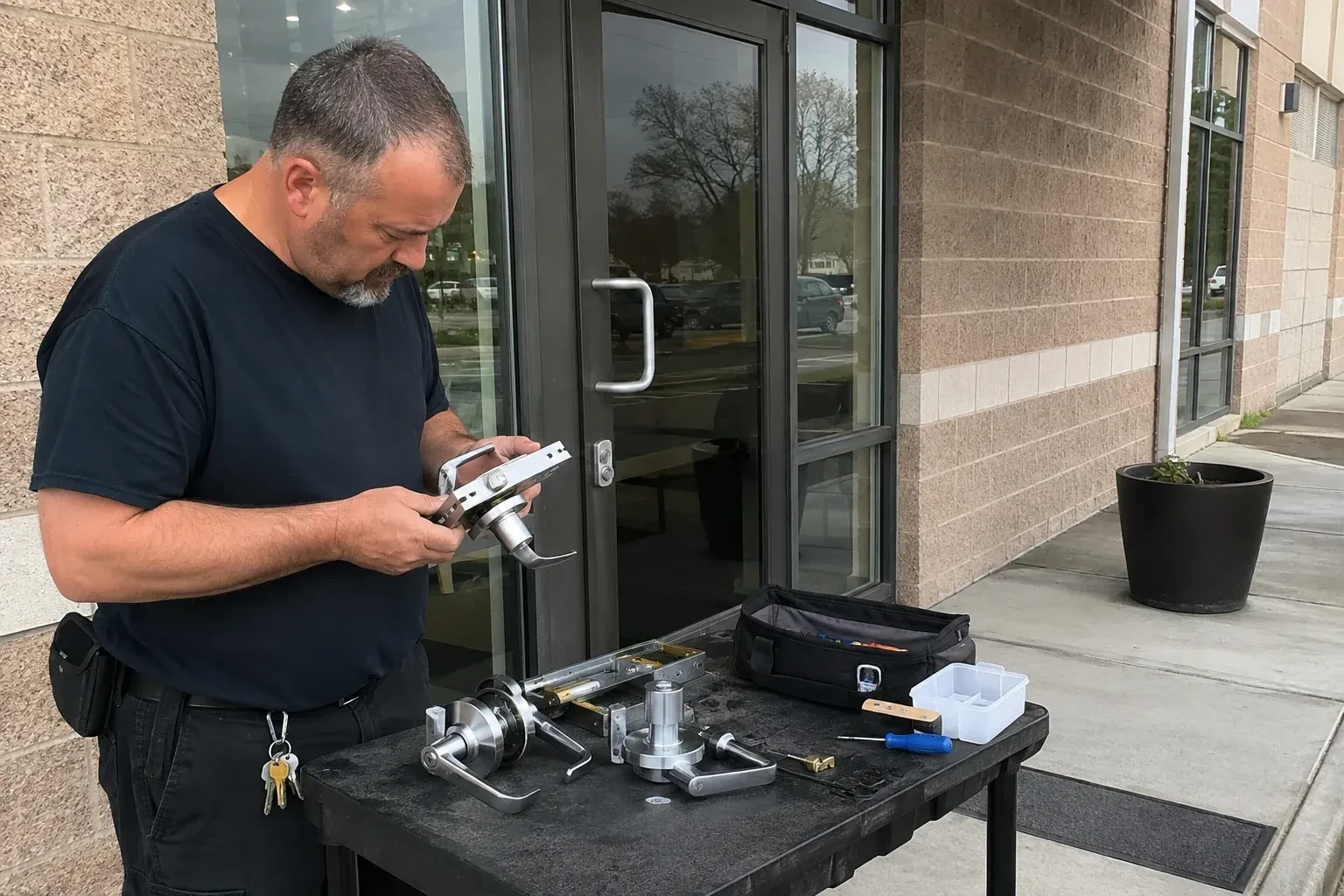
A cylinder about to be repinned is examined the way a mechanic looks over a part before rebuilding it. The plug should turn smoothly with the right key, the pins should spring back cleanly, and the face should be free of the green bloom that salt spray leaves on storefront hardware after a few winters. The locksmith also checks how the door closes: a strike that no longer lines up, a closer that slams, or a deadlatch that fails to catch will keep a freshly rekeyed door from locking properly. Most cylinders pass and are repinned; a worn or corroded one is pointed out so you can choose a replacement for that opening.
- 2
Cutting and marking the new keys
Keys are cut to the new combinations on a code machine rather than traced from another key, so every copy is exact and the tenth key fits as cleanly as the first. Each key is stamped with a short code that means something only on the keying chart; the business name, the address and the word for the door it opens stay off the metal, so a lost key gives nothing away. Keys are counted out by group, tagged, and listed against the names of the people who will carry them. Where the plan uses a restricted keyway, the blanks are drawn against the authorization letter, and that letter is filed with the chart for future orders.
- 3
A keying chart in plain language
You leave the visit with a one-page chart that lists every opening by name, the key group it belongs to, the code stamped on that group's keys and how many were cut. It is written for the manager, not the locksmith: the stockroom is called the stockroom, and a glance shows that key group B opens the office and the cash room and nothing else. The bitting details that a locksmith needs to add a cylinder later are kept separately and securely. Pin the chart inside the manager's cupboard, keep a copy off site, and it becomes the reference every future key question is answered from.
In the van
- Key stamp set and tags
- Master pins
- Mortise cylinder set screws and cams
- Key gauge and decoder
- Code key machine
What affects the quote
- 1
Mix of lock types
A key-in-lever cylinder, a storefront mortise cylinder, a back-door rim cylinder and a padlock take different handling, though several full-size formats can share one pin kit for the same key system; a premises with a wide mix of cylinder types and brands still takes longer than one with one.
- 2
Number of cylinders
The count of openings drives the quote more than anything else: each cylinder is removed, repinned, refitted and tested individually, so a three-door shop and a twelve-office suite are very different jobs.
- 3
Distance to the premises
Travel to the site is part of the call-out, and a unit in a downtown plaza and one at the end of a rural industrial road are different trips.
Same fees day, night or weekend.
Commercial Rekeying: questions
What is an interchangeable core and why is it suggested for staff turnover?
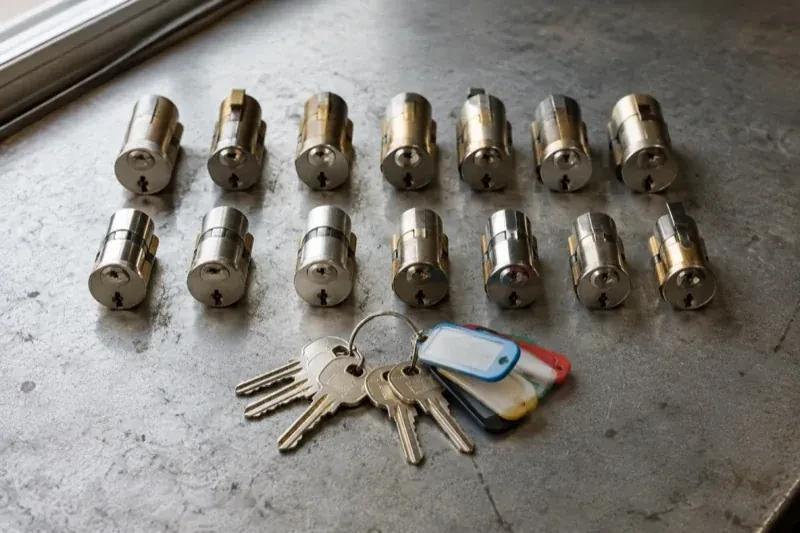
A small-format interchangeable core is a small figure-eight cylinder that slides out of the lever, deadbolt or padlock when a control key is turned, with no tools needed; larger doors sometimes use a large-format core with a different profile instead. A manager keeps the control key in the safe and a few spare cores on hand, so a missing key means the core is swapped in moments and repinned later. For a business with frequent staff turnover, it turns a call-out into a routine.
We lost a master key. Does the whole building need doing?
Only the cylinders that master opened, which the keying chart identifies. If the lost key was the top master, that is every lock in the system; if it was a departmental master, it is that department's doors. Where no chart exists, the locksmith reads the cylinders first to establish what the key reached. The remaining doors, and any keys that never opened them, are left exactly as they are.
What condition does a lock need to be in to be rekeyed?
It needs a plug that rotates without catching, pins that return under their springs, and a face free of heavy corrosion or cracks. Most commercial cylinders in daily use pass easily. Ones that are stiff, gritty or green with salt bloom can sometimes be cleaned and repinned, and the locksmith will say when a replacement for that door is the better value; the rest of the doors are rekeyed regardless.
Commercial Rekeying near you
Toronto, Ontario
Highfield information
- Town
- Highfield, Toronto, Ontario
- In business
- 22 years
- Hours
- Open 24/7 · nights, weekends and holidays, same fees
- Phone
- (289) 804-8591
- Visits
- On-site assessment preferred. Request a visit or call.
What the census means at the door
58%
Older homes. About 58% of homes in Toronto were built in 1980 or earlier, according to the 2021 Census.
Older homes tend to have had many hands on their doors: owners, tenants, tradespeople, family. A locksmith visiting such a house pays attention to who holds keys now, and rekeying or a keyed-alike set often matters more than any new hardware.
23%
Single-detached houses make up about 23% of homes in Toronto (2021 Census).
Shared entrances mean fobs, intercoms and buzzers alongside conventional locks. A locksmith can service the mechanical side of those doors and advise on how the fob system and the cylinder work together when management asks.
Open 24/7
Request a visit
The drawer behind the counter holds a tangle of keys with tape labels: front old, side, Dave.
Call now · open 24/7(289) 804-8591- On-site assessment preferred
- Same fees day, night or weekend
- 22 years in business